
Improv Tips for DMs (and players)
How to make memorable characters come alive with zero prep

As a GM there are some things I prep obsessively. My campaign setting has a list of trade goods which is detailed enough that it includes prices for more than one type of cheese, and yes, this has come up in game, and no, I don’t recommend that other DMs do this.
However, there are other things you can’t really prepare for. What if the players decide to interrogate one of the random guards you placed in a dungeon to be summarily killed? You can’t be expected to create a personality for every token that you plonk down on a map. What if they ask to speak to the manager of the magic shop because they’re frustrated that the front desk clerk refuses to negotiate? Now, you suddenly need to improvise a character that didn’t even exist until that very moment…
What’s a DM to do?
These types of situations come up in my games all the time but fortunately I am always prepared to be unprepared. Mostly it comes down to embracing the ethos of improv - adopting a set of interconnected attitudes and dispositions that put you in the right frame of mind for doing character work - but there are also a few distinct skills and techniques you can try to really take your improv to the next level.
The Improv Mindset
The Improv Mindset is about being fully immersed in a scene and fully open to working with the other characters in the scene. Immersion is simple: it just means that all of your attention is focused on the scene and what is happening in it. If you’re tuning out during a scene - like if you’re checking twitter when the spotlight isn’t on your character - then you aren’t immersed, and when it comes time for your character to act you won’t be present in the scene enough to respond. As a player or as a DM I try to minimize distractions, making sure I’m in a quiet room, putting my phone out of sight and on mute, and closing all of my social media tabs.
Even if you’re not actively talking, you can be immersed by actively listening, or by thinking about your character’s goals and motivations in the scene. You can take in details or even make notes. If you’re playing in person, active listening might involve giving nonverbal feedback to your scene partners - such as nodding along when you agree with what someone else is saying.
Being fully immersed makes it very easy to Say the Obvious Thing, which is one of my go-to moves for improv. A character doesn’t have to be clever, or funny, or impressive in any particular way to create a good scene. Usually all you need to do to keep a scene moving is to say the next Obvious Thing, and the more immersed you are in a scene, the more obvious the Obvious Thing will actually be.
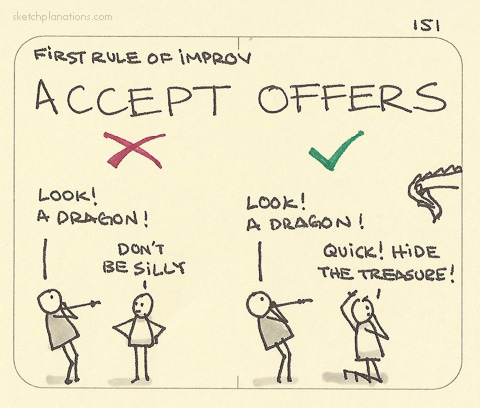
If you’ve taken an improv class you might have heard that the First Rule of Improv is “accept and build” or “say yes, and…”, and this rule is a big part of what it means to be open to working with the other characters in the scene. You’re building a shared reality together, and you want to accept each piece of the shared reality and then build upon it. This means you have to give up some control over the scene - to accept that it might go in a direction you hadn’t planned out - in order to make the scene flow freely and feel real.
Building upon what came before often means adding a specific detail, which someone else in the scene can then build off of in turn. I’ll illustrate this with an example.
The Threat
A few weeks ago my players decided to interrogate a guard instead of killing him. They started off by discussing whether they should let the guy live and interrogate him or just finish him off. I decided to have him plead for his life.
“Please don’t kill me… I wasn’t even supposed to be here today! I’m just filling in for my partner. His wife is having a baby so he needed to take off-”
At that point, the party Face cut him off. “I don’t care. If you ever want to have the opportunity to start a family of your own, you’ll tell us what we need to know.”
That ended up being a fantastic line and a memorable moment. It also showcases the Improv Mindset. The scene worked because everyone was fully involved - the guard was listening and responding to the players, and the players in turn listened and responded to the guard. The guard said the obvious thing - “please don’t kill me” - and the player accepted what the guard said and built on it to deliver a truly intimidating, personalized threat to this character.
Aside from saying the obvious thing - “don’t kill me” - the guard added a specific detail - “I’m only here because my friend is having a baby.” That detail gave the player something to build off of to create a specific, memorable line, rather than a generic, forgettable threat. These types of details make the whole scene come alive. They also humanize the NPCs, making the players really think about their actions before they have their characters go off on a murder spree.
Adding Details
While the Improv Mindset - being immersed and open - is mostly just about an approach to roleplaying, adding details can be pretty tricky and involves a few different skills. You’ll need to exercise visualization, memory, and creative thinking skills to get really good at giving your characters strong, memorable details. You’ll need to make strong choices and then commit to them.
When I had to give this guard a line, I had to make a choice about who this guard was. Was he a brave, heroic soldier, who would die before giving up the secrets of the location he was guarding? Or was he a poorly-paid mercenary who would fold like a bad hand at the first mention of death or dismemberment? Based on the context - a low CR guard on the outer periphery of this dungeon - I decided on the latter.
What about the friend going to spend time with his pregnant wife? That seems like a very random detail, but in fact this is now the second time the PCs have been exposed to the idea that the empire they are fighting against places a high value on bearing children. Seemingly random NPC comments can be a good way of communicating worldbuilding details about the cultures players are interacting with. What sorts of foods would they eat? What do they do for fun? What would be a valid excuse for taking off work?
I actually keep a list of cultural characteristics and values for each of the main cultures in my game and whenever I need a detail I try to remember to pick one off the list. In Hill Valley, the economy is centered around raising cattle (hence the cheese varieties offered for trade being a detail). In the Dominion, the economy is more centered around war and expansion, and a good citizen is one who has lots of kids to feed the war machine. I also keep a few bits of local lore handy for characters to encounter when they talk to the locals.
Aside from details about the world, add details about the characters. A character might have a particular speech quirk or catchphrase. You don’t necessarily need to do accents - especially for characters from the same region, who might reasonably all have the same accent - but you can raise or lower your vocal pitch to have simple differentiation between characters based on voice. You can also add random behavioral or physical quirks - a character who is always tugging nervously at their ear, a character who laughs at inappropriate times, a character who gesticulates wildly while talking, etc. Having a character doing something - pacing, cooking, eating, drinking, etc. - is more evocative than having a static character who just talks.
Of course memory helps here - in case the PCs encounter the same character again later - but notetaking helps more. I have on occasion made characters which were more memorable to my PCs than they were to me, and a player has brought up some character detail that I had to check my notes about. Whatever major character choices you make, write them down as soon as possible, while they’re fresh in your memory.
You can also “cheat” by basing your NPCs on archetypes or on other characters from other media. I have an NPC whose roleplay note is “talks like Mr. DeMartino” and another whose note is “talks like Grand Nagus Zek”. Neither of these are particularly creative or inspired choices - they don’t have to be, because the point of NPCs isn’t to steal the scene from the players. They just need to be distinct enough to give players a reference point during interactions, and memorable enough to give me a quick mnemonic for jumping back into that character again later if need be. If I’m being honest, if I need to come up with a voice for an NPC on the fly, probably at least half the time I’ll have a specific character in mind as my model for the voice.
A warning here: it’s probably better if you don’t make these “borrowings” so obvious or over-the-top that it breaks immersion. The goal isn’t to give characters from other media cameos in your game world. I’m not going to make a ship captain named Kirk and have his first officer be a half-elf named Spock. But I might have a character who talks with odd… pauses… once in a while, or a character who is stoic and says “fascinating” a lot.
Keeping track of details is enormously helpful for improv because it helps you visualize a scene, and it can tell you what the next Obvious Thing to say is. All it takes is one or two specific details to make a character feel like a real part of your world, especially if these details are consistent enough that they help to paint a picture of what your world is like.
Here it is again, in list format
1. Immerse yourself fully in every scene. Minimize distractions, listen actively, and respond in character.
2. Work with other characters. Accept what they give you and build on it. Great scenes are built on this back-and-forth interaction.
3. Say the Obvious Thing. You don’t need to steal the show or impress anyone. What’s “obvious” can come from the scene or from the story you’re trying to tell.
4. Add character details. Be specific and keep track. Use the details to paint a picture of a character, a culture, or a setting. Refer back to them later for consistency and to make it all feel real.
If you’d like to see me put these tips into practice, come join a game with me! I’m running games through StartPlaying, where you can join one of my campaigns or contact me to book a custom game. Head over and check out my GM profile!